Eroom's Law
For sixty years each billion dollars of drug R&D bought fewer new medicines. These studies rebuild that curve from primary sources and take it apart: what trials cost, how big they have to be, what regulators accept as evidence, and where the exceptions are.
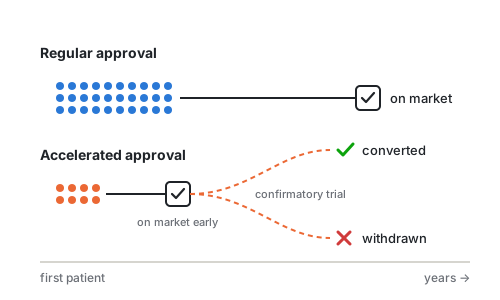
Accelerated approval: faster drugs, and the bill that comes after
The FDA can approve a drug early on a stand-in measure like tumour shrinkage, on condition that a confirmatory trial proves real benefit later — but does that shrink trials, and are the promises kept? Explore every accelerated approval since 1992: how often it is used, how the pivotal trials differ from regular approvals in the same field, and what happened to the confirmatory trials.
Open study →
What a clinical trial costs per patient
Everyone assumes clinical trials grew more expensive per patient as American healthcare did, but nobody had measured it — in 1993 the Office of Technology Assessment said the cost "must have increased dramatically" and that it could not verify by how much. Built from federal trial budgets back to 1954 and the per-case rates funders post, it finds no detectable trend in real cost per patient, and shows that what a trial costs is set by how it is designed rather than by what decade it runs in.
Open study →
How big does a drug trial have to be?
The pivotal trials behind drug approvals grew from a few dozen patients to thousands — but the growth is really about which endpoint the regulator demands, short-term measurable markers or long-term clinical outcomes. This app assembles a sourced database of pivotal trials across oncology, diabetes, cardiovascular disease, osteoporosis and COPD, and charts enrollment, duration and endpoint type over seven decades, with the moments regulators mandated outcome trials marked — and, for 1,657 new drugs, how many years passed between the molecule's patent or first paper and its approval.
Open study →
Is HIV an exception to Eroom's Law?
HIV went from a death sentence to a once-daily pill with a steady stream of new drugs, which looks like an escape from the sixty-year slowdown in drug development — often credited to the FDA reforms AIDS activists won. Built from every pivotal trial behind every FDA-approved HIV drug and the other anti-infectives of the same years, it shows HIV trials were never smaller than other infections', and that what set HIV apart was a lifelong disease keeping a short, trustworthy blood-test endpoint — plus how new drugs like lenacapavir still clear the bar when current pills already work.
Open study →
What we tested drugs in
Before a drug reaches a person it is tested in a mouse, a dog, or a dish of cells — and those stand-ins are supposed to predict what humans will do. This traces what the stand-ins actually were from 1966 to today, what happened to the drugs that passed them, and why the obvious correlation between the two cannot honestly be computed.
Open study →
Eroom's Law, extended and decomposed
For sixty years each billion dollars of pharmaceutical R&D bought fewer new medicines — a decline so regular it was named Eroom's Law, Moore's Law backwards. Rebuilding the curve from primary sources and carrying it to 2025 shows the decline stopped around 2000, and breaking it down by disease area and molecule type shows where the money now goes and what it still buys.
Open study →